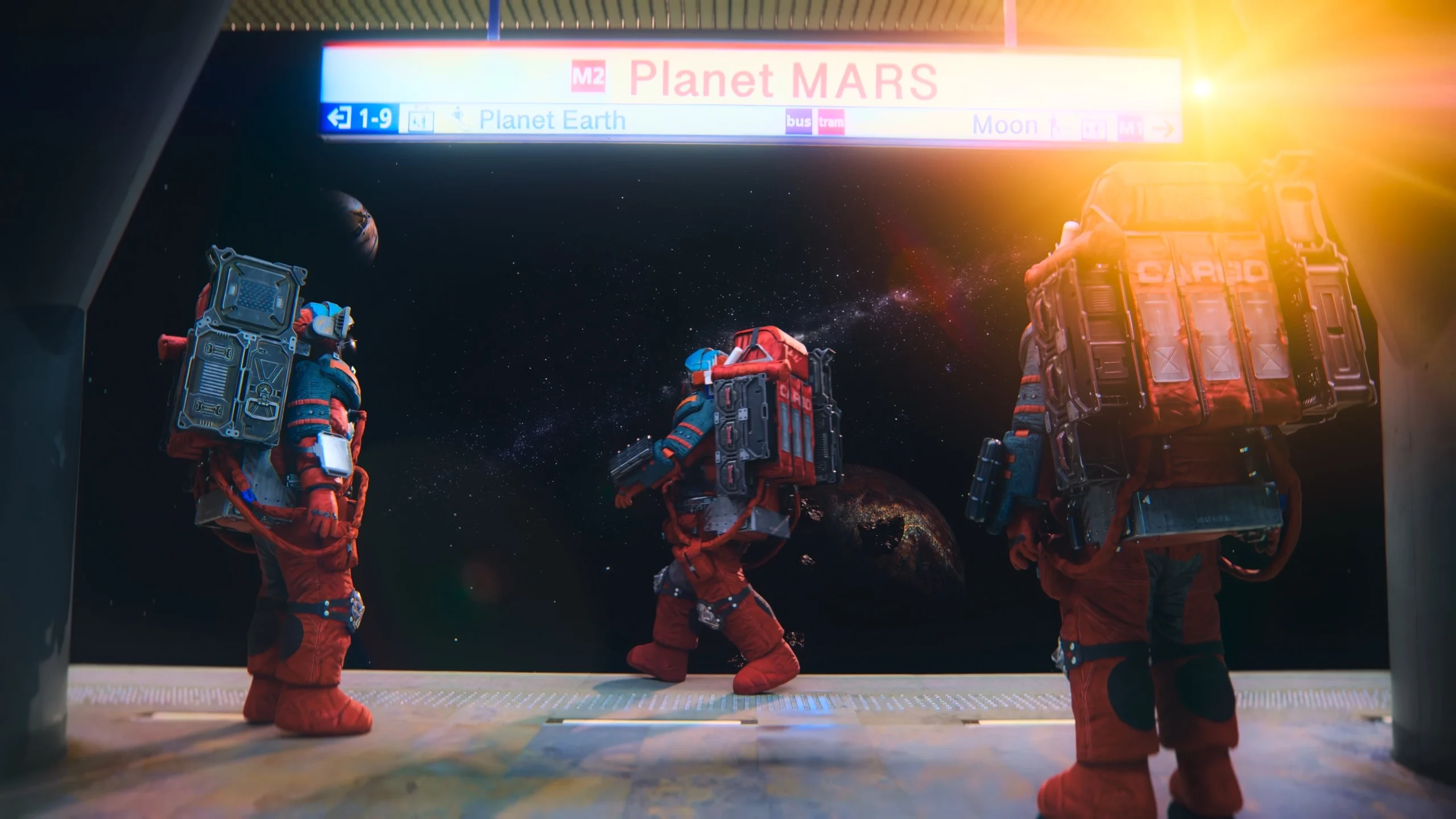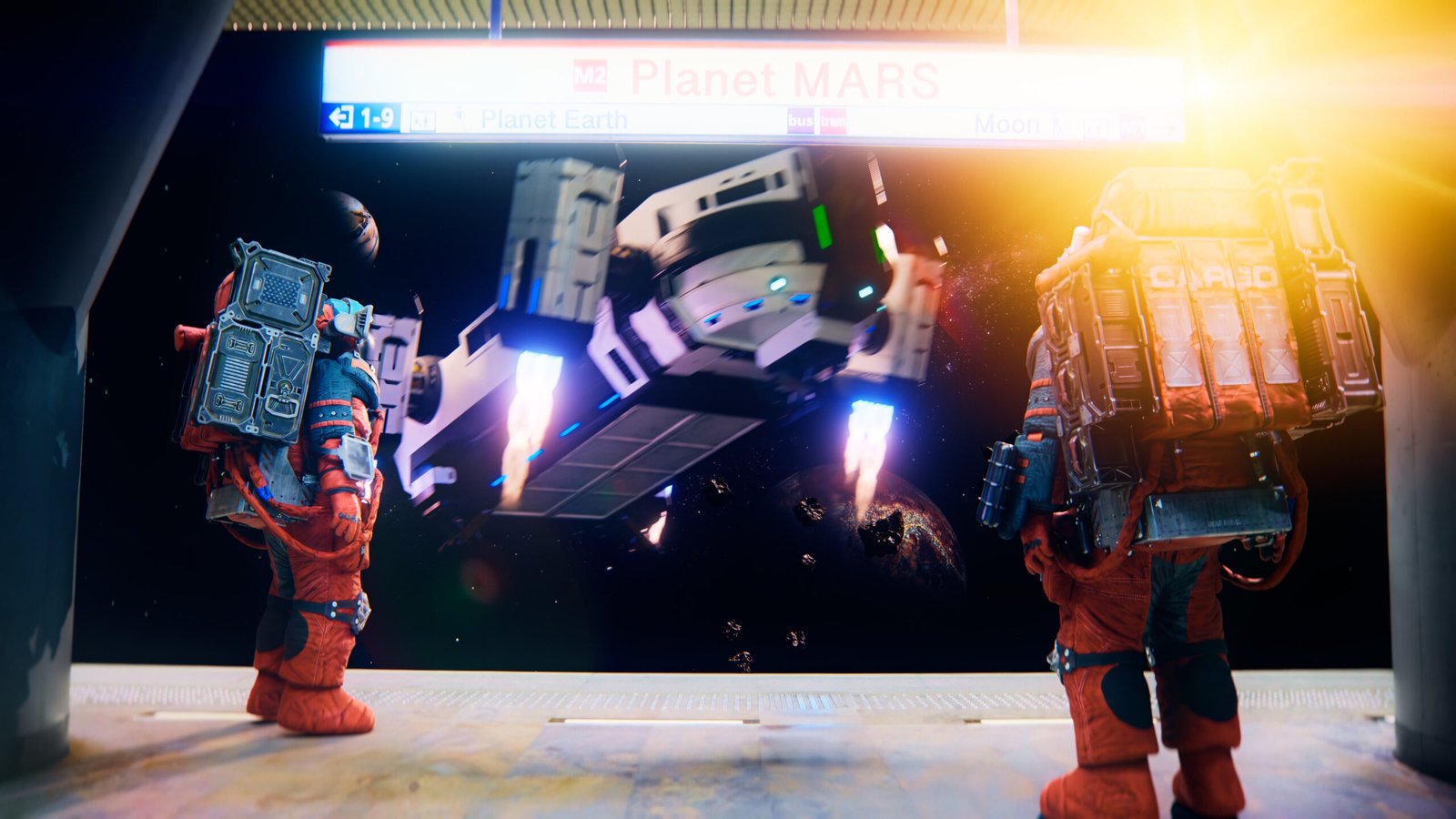
Metro Space Station: Turning A Metro Station Into A Martian Outpost
Objectives
My objective on Metro Space Station was to engineer a seamless photorealistic composite that holds up under scrutiny: matching live-action lighting temperatures, realistic camera motion jitter, depth-of-field rolloff, and atmospheric Martian dust interaction without visual telltales.
1. 3D Camera Tracking & Matchmoving (SynthEyes)
Seamless VFX integration relies on a rock-solid camera solve. Because the live-action plate was captured handheld with natural motion and lens breathing, achieving an error-free 3D coordinate system was critical:
| Tracking Metric | Pipeline Specification | Technical Purpose |
|---|---|---|
| Solve Error (RMS) | < 0.42 pixels | Eliminates spatial sliding between digital astronauts and the station floor tiles. |
| Lens Distortion Profile | Radial 4th-order polynomial | Undistorts live-action footage for 3D alignment, re-applying distortion to CGI layers at output. |
| Ground Plane Survey | 3D proxy mesh aligned to metro platform | Provides accurate shadow-catcher surfaces and physical contact points for character feet. |
2. Digital Set Extension & CGI Asset Integration (Blender 3D)
Once the tracked 3D camera was imported into Blender, the environment and characters were assembled in physical world units:
- CGI Astronaut Assets: Modeled and textured heavy EVA space suits with reflective gold-tinted visors, tactical utility packs, and dynamic cloth micro-wrinkles.
- Lighting Extraction & Matching: Created an HDRI lighting rig combining the overhead fluorescent tube banks of the metro station with low-intensity 4200K fill lights and warm 600nm red Martian exterior ambient bounce.
- Shadow & Reflection Catchers: Projected the station platform geometry as an invisible shadow-catcher material, capturing soft contact shadows and subtle specular reflections on the glossy floor tiles.
3. Multi-Pass Node Compositing (Blackmagic Fusion)
The compositing graph in Blackmagic Fusion assembled the live plate with 32-bit linear EXR render passes, performing optical harmonization across all layers:
[Live Plate] —> [Lens Undistort] —> [Clean Plate Patching / Roto]
│
[Blender 32-bit EXR Passes] ————-> [Multi-Channel Merge]
├── Diffuse / Specular / Emission passes
├── Shadow Catcher (Multiply with alpha=1.0 force)
├── Visor Environment Reflection (Screen blend)
└── Volumetric Martian Dust Particle Layer
│
[Optical Pass] -> [Light Wrap + Chromatic Aberration + Re-Distort] -> [DaVinci ACES Grading]
4. Atmospheric Martian Color Grading in DaVinci Resolve
The merged composite was imported into DaVinci Resolve Studio for final color harmonization within an ACEScct workflow:
- Environment Palette: Balanced cold architectural fluorescent overheads (5600K) against rich rust-red atmospheric haze (3200K warmth in midtone rolloffs).
- Depth Haze Integration: Injected subtle depth-based atmospheric scatter derived from the Z-depth EXR channel, fading distant platform corridors into a dense Martian mist.
- Film Grain Matching: Analyzed the ISO noise floor of the original camera sensor and synthesized matching 35mm grain across all CGI render elements to eliminate digital smoothness.
5. Production Impact: Location VFX vs Full CGI Build
| Production Parameter | Full CGI Environment Build | Live Plate + VFX Set Extension | Efficiency Gain |
|---|---|---|---|
| Environment Modeling Time | 3–4 weeks (modeling, texturing station) | Zero (captured live in-camera) | 85% time reduction |
| Lighting Photorealism | Synthetic illumination calculations | Real physical photons & surface reflections | Organic realism |
| Iteration Agility | Hours per full frame render | Fast render of isolated character passes | Rapid director reviews |
6. Technical Specifications & Tool Stack
- Camera Matchmoving & Tracking: SynthEyes
- 3D Asset Creation & Lighting: Blender 3D (Cycles rendering engine)
- Node-Based Compositing: Blackmagic Fusion Studio
- Color Grading & ACES Management: DaVinci Resolve Studio
- Master Delivery Format: Apple ProRes 4444 XQ / 4K UHD
7. Technical FAQ
How do you match CGI lighting to live-action fluorescent tubes?
By measuring the physical distance and color temperature of the station’s light fixtures, identical light sources are positioned in Blender relative to the 3D tracked camera, ensuring shadow angles and specular highlights on the astronaut suit match the live plate exactly.
What is the benefit of using SynthEyes over built-in camera trackers?
SynthEyes provides advanced lens calibration, automated radial distortion mapping, and complex constraint solvers, ensuring sub-pixel accuracy even on footage with aggressive panning and optical motion blur.
How do you prevent CGI elements from looking ‘pasted on’?
The secret lies in optical integration: extracting grain from the original camera plate, simulating light-wrap around character edges, and matching the exact lens diffraction and chromatic aberration of the capture lens.
Visual Showcase